Namo Tassa Bhagavato Arahato Samma Sambuddhasa
Homage to Him, the Blessed One, The Worthy One, The Perfectly Self-Enlightened One
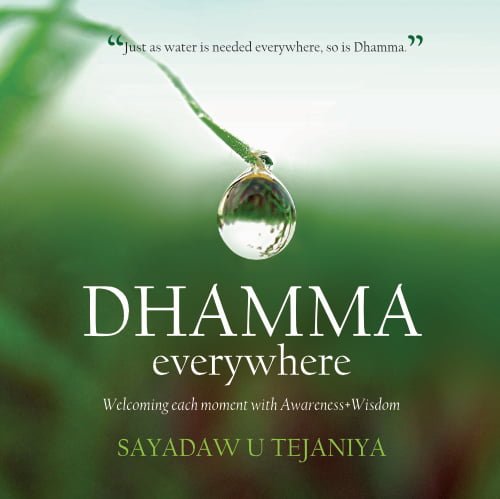
(First Printed in 2011)
CONTENTS
ACKNOWLEDGEMENTS
My special gratitude goes to my teacher, the late Venerable Shwe Oo Min Sayadaw
Bhaddanta Kosalla Mahā Thera, who taught me Dhamma and the right attitude for my spiritual development and meditation practice.
I want to express my appreciation to all yogis. Their questions and difficulties have once again inspired many of the explanations in this book. I really hope that this book will help yogis to better understand mindfulness meditation and to deepen their practice.
Finally, I would like to thank everyone who has contributed to the completion of this book.
Sayadaw U Tejaniya
Myanmar
DEAR READER
Sayadaw U Tejaniya’s style of teaching and emphasis has always been dynamic, evolving with his own experiences and recognition of yogis’ difficulties with the practice. This book is an attempt to capture his teachings at this point in time but Sayadaw U Tejaniya keeps coming up with new and better ways to explain things!
We have collected Sayadaw U Tejaniya’s teachings from several sources and contexts to include a breadth of material that will hopefully resonate with beginner and experienced yogis alike. Included are translations from Burmese: The little blue book on the right attitude for meditation and selections from
Dhamma discussions and morning Dhamma reminders at the Shwe Oo Min Dhamma Sukha Tawya Meditation Center. We have rounded out the topics with transcriptions of morning Dhamma reminders given in English.
Like the first two books, this book has been produced for yogis practicing at the Shwe Oo Min Dhamma Sukha Tawya Meditation Center. As such, some words and terms used here may not be used in the same way or with the same meanings elsewhere (more in A Note on Words). May you find the book to be a source of information and inspiration, from What is Mindfulness Meditation? and Right Attitude 101 to excerpts of Dhamma discussions in In a Nutshell and Dhamma in the Mornings. Please note that this book is by no means meant to replace the personal guidance of the teacher.
We have tried to translate and express Sayadaw U Tejaniya’s teachings as accurately as possible. Please excuse any errors in translation and details that may have gotten lost in the process. Kindly contact us with suggestions for future publications.
Our deep gratitude goes to Sayadaw U Tejaniya for patiently lighting the path of awareness+wisdom and teaching us the right attitude for meditation. May all living beings benefit from the combined efforts of those who have contributed to this process: Margaret Smith, Katherine Rand, Chan Lai Fun, Hor Tuck Loon, Becky Chan, Karen Recktenwald, Bhante Abhayaratana, Bhante Khemacara, Preethi Dissanayake, Sriya Tennakoon, Sister Khema, Cheong Thoong Leong, Sister Mayatheri, Maxine Cheong, SSW, Albert Lee, Susa Talan,
Alexis Santos, Steve Armstrong, Nancy Zan, Yopi Sutedjo, Hirok Ghosh, Sister Co Minh, Zaw Minn Oo, 1-2, Ma Thet, Walter Köchli, the publishing teams, and anyone unintentionally left off here!
Laura Zan
Translator & Compiler
A NOTE ON WORDS
We work within the limits of language and concepts to describe and give suggestions for a process of clear seeing that is at times difficult to pin down with words. As such, when reading this book, please don’t adhere tightly to dictionary definitions or rules of grammar.
You may notice a new combination word “awareness+wisdom” in the title and in parts of the book. It is Sayadaw U Tejaniya’s way of underscoring the need for more than mere awareness in vipassanā. Awareness alone is not enough; wisdom must also be present with the awareness on this path of learning and understanding.
Constructs like “the mind is knowing” (versus “the mind knows”) are used in instances where it seems more appropriate to describe something in process. The following words are used interchangeably: watching, being aware, observing, being mindful, and paying attention. Finally, “Dhamma” with a big “D” refers to the teachings of the Buddha, the practice of meditation while “dhamma” with a little “d” refers to natural phenomena, natural law, or object.
Pāli and English words have been used in combination throughout the book.
Sometimes the English translation is only an approximate, short description of the actual Pāli meanings, but the explanation should be adequate for the practice of mindfulness meditation. Do refer to the glossary of Pāli terms at the end of book and consult Buddhist dictionaries and texts for more complete definitions. “Try to get a ‘feel’ for Pāli terms when you hear them; try to understand them in context” is advice we will repeat here from Sayadaw U Tejaniya’s book Awareness Alone is not Enough.
Finally, in order not to have to decide on the use of “she” or “he” in describing yogis’ experiences (as well as the use of “we” or “you” in the explanations), we have given a fair chance to each of these concepts.